Grey wolves are found in North America, Europe and Asia (from the Arctic in the north to as far as Mexico in south). However, these large carnivores have disappeared from many areas because of hunting. People often fear wolves although, despite their grizzly reputation, wolves rarely attack humans.
These types of wolves vary in size. The largest wolves and found in the north. They also vary in colour, from grey and brown fur to almost black and white wolves live in the Arctic tundra. wolves use facial expressions, body language AND sound to communicate with each other. They howl to let other species know where they are whilst they are hunting or defending their territory.
Wolves often hunt large prey e.g caribou moose, musk oxen. These animals are very dangerous. Although individual wolves can attack on their own, they usually hunt prey in a pack.
Here are some facts you may not know about grey wolves:
1 – Wolves use many cues to find prey, including scent and visual information. Once the prey is located, they get as close as possible without being seen
2 – Wolves chase prey and make them run so they can find the weakest members of the herd to attack, which in this case is called caribou calf
3 – The caribou The calf runs in the opposite direction to its mother and caught by the wolves
Wolves usually live in packs of 2 – 40 animals. There is a clear order in each pack of wolves. The alpha male and female are dominant – they eat first at a kill and are the only animals in the pack to breed. This wolf below is showing dominant behaviour. Lower ranking wolves show submissive behaviour, which includes crouching and holding their ears back and down.
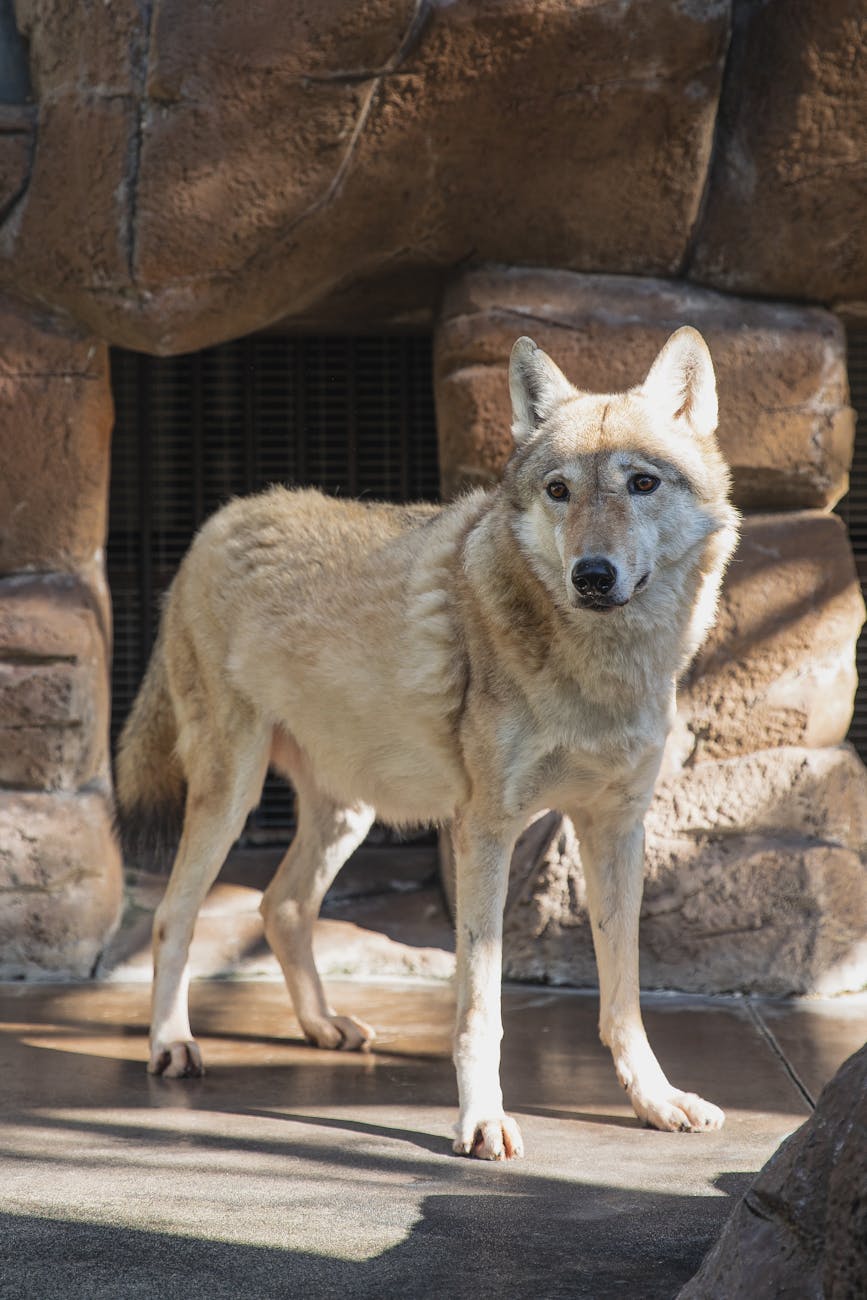
Grey wolves violently use their body to attack. Firstly, when showing aggressive or dominant behaviour, the hairs on the back of a wolf’s neck stand on end. These hairs are known as the wolf’s hackles. Domestic dogs also behaviour in a similar way. Another scary thing about grey wolves is they have strong jaws and sharp teeth. It uses its long, curved canines to grasp prey, while its teeth further back slice the killed animal into chunks that the wolf can swallow. Eye contact for wolves is also important. As a dominant animal looks a lower ranking wolf in the eye . Additionally, wolves have scary snarls! A wolf snarls to show its sharp teeth. Its snarl may be a sign dominance or aggression, or part of the wolves self defence.
Wolfs have many relatives. The coyote is closely related to, but smaller than a grey wolf. They are found across North and Central America, other than the far north of Canada. Despite its name, the wolverine is not a member of the canid family. It is more closely related to stoats, weasels and otters than it is to dogs, suprisingly. The Arctic fox is also similar to grey wolves. Arctic foxes are small predators found in the arctic regions. Its muzzle, legs and ears are short compared to those of other canids.
 Bella's World